Mostrando entradas con la etiqueta Spanish. Mostrar todas las entradas

miércoles, 17 de octubre de 2012

Tile of Cream Patamulo Cheese with Crispy Ham from Teruel


Today we will make a recipe using two of the most typical products of Aragon, specifically in the province of Teruel. Patamulo Cheese from Bajo Aragon has its heart in places like the small village of Samper de Calanda. It has a nice texture, and very distinguished tastes that is easily identified. Made by the traditional way, its curing process is from 2 to 4 months. And the Ham fromTeruel PDO is definitely the star of the products of the province, and a pride for all Aragonese and Spanish. Followers of this blog and Antonio Mata perfectly know the virtues of this excellent cured ham. Let's see how to prepare an appetizer that is a perfect combination of cheese and ham:

TILE OF CREAM PATAMULO CHEESE WITH CRISPY HAM FROM TERUEL

Photo www.elmundoiberico.com


Ingredientes:
  • Ham from Teruel PDO by Antonio Mata
  • 250 grams Patamulo Cheese
  • Pedro Ximénez Reduction
  • 2 egg whites
  • 20 gr. sifted flour
  • 20 gr. butter cream point
  • Milk
  • Cream
  • Butter
  • 1 pinch of salt
  • Black pepper


Preparation:

To make the cream cheese Patamulo, heat it over high heat 150 ml of milk and 150 ml of cream and butter. Season with salt and black pepper. When very hot add the cheese Patamulo (previously diced) and we will remove constantly until melted. Tip, if it is too runny, let's take a little cornstarch to thicken.

To make the tiles: Preheat oven to 180 º C. Whisk the egg whites until stiff and mix hard with butter and flour until a smooth dough. Put baking paper on a tray and make mounds with the dough. They should be round and we have to crush them flat. We'll leave in the oven for about 10 minutes until golden and then remove and let cool. Meanwhile, in another pan put 3 slices of Ham from Teruel PDO by AntonioMata. We'll leave them until the texture is crunchy. Surely the ham will take longer than the tiles.

Once made the ham, chop it and mix well with the cream cheese Patamulo. To serve, we will make a ball of cream cheese and ham on each tile and add a little ham over each ball. We can add a dash of Pedro Ximénez reduction.

And that's it. This is a dish that you shall be as great chefs before your guests but not a very complicated processing. We hope you feel encouraged to try at home.

See you next Friday with more recipes and tapas!


viernes, 7 de septiembre de 2012

Chorizo with prawns

As we promised last Wednesday, today we are going to tell you how to make one of the most appetizing tapas recipes: Chorizo with prawns.

You know that chorizo is a spicy cured sausage, typically Spanish, so this recipe is going to be quite hot.

Photo: http://bit.ly/QqS5qU

Ingredients: 

  • 2 garlic cloves
  • 2 tablespoon olive oil (we recommed Spanish oil)
  • 300g Spanish Chorizo by Antonio Mata
  • Coarse salt (or sea salt)
  • 50ml dry sherry 
  • 8 medium-sized prawns 
  • 2 tablespoon chopped fresh parsley


Preparation: 

First of all heat a frying pan (you can use a terracotta casserole as well) until medium hot. Add the olive oil and sliced garlic for 1 minute. Cut crosswise the chorizo into 1cm chunks. Then add the pieces and fry for 2 minutes, until chorizo is sweating.

Peel the prawns and add them to the pan with a bit of coarse salt. Fry for 3 minutes (until prawns get pink). Finally add a good splash of sherry and reduce it.

Add chopped fresh parsley and a bit of coarse salt. This type of salt enhaces the flavors, especially in sea food.

That's it! See you next Wednesday with new tapas recipes and Spanish gastronomy. 

martes, 7 de agosto de 2012

Tapas: Melon stuffed with Cured Ham from Teruel


With the high temperatures of the summer time, always like eating something chilly to help us alleviate the feeling of warmth. Today we propose a very simple tapas recipe, really traditional and perfect for summer: Melon stuffed with Cured Ham fromTeruel.


Ingredients:


Preparation:

Cut the melon in half and make balls with a spoon (medium size ice-cream spoon would be perfect). Empty the top of each ball with a small knife, just a small hole. Reserve in a tray.

Place the toasted pine nuts in a bowl and mash them a bit. Add balsamic vinegar (may be from Jerez, Spain) and the olive oil. Emulsify.


Cut small slices of Ham from Teruel (could be any Spanish Cured Ham), roll and fill the melon balls.

Serve on a tray, place the melon balls filled with cured ham in a side and the vinegar sauce in the other side. Add just a bit of Maldon salt, black pepper and a drop of oil to every melon ball. Tip: add just bit of salt, ham is salty in itself.


Enjoy this chilly and delicious tapa. Que aproveche! 

via mis-recetas.org     

viernes, 3 de agosto de 2012

Tasting Extra Virgin Olive Oil: how to do it and aspects to be considered


One of the main products of Spanish gastronomy is the so called ‘Green Gold’. The best olive oils in the world are produced in Spain, are a very healthy food (thanks to oleic acid, same as Spanish Cured Ham), and an excellent seasoning for our recipes also.

Olive oil is one of the most appreciated flavours of the world, but do we know how to tell its quality? Or appreciate the nuances of their different flavours? Here’s some small tips of how to make an olive oil tasting.

For an olive oil tasting, we must realize what aspects exactly we can rate with our senses. So, we can use the smell, sight, taste and touch. These help us in the analysis of aromas and flavours.

First of all we pour a bit of olive oil in a cup and cover it with a glass. In this way aromas are concentrated and will be easier to appreciate. After a few seconds uncover the cup and proceed to smell the oil with short breaths.

Then turn to taste it. Take a small sip of olive oil and scatter it around the mouth. We can perceive the four basic tastes (sweet, salty, sour, bitter) and the characteristic flavours of oil that we are tasting.

After that, we can evaluate the colour, fluency or feeling to the touch. You should wait more than fifteen minutes from one test to another to remove the remains of the mouth. Chewing a piece of apple a few seconds can help us. Once the tasting is made, we can ascribe different features:

Sweet touch: absence of bitter or spicy flavour.

Bitter touch: olive varieties are more bitter than others. Olive oil can be made with fresh green olives.

Green leaves: if the olive is very green and has been ground with pieces of leaves and stems, may have these nuances.

Grass: some oils remind freshly mown grass.

Fruity touch: remind the smell of fresh fruit at its peak of ripeness.


It’s also possible to perceive defects. Some of the easiest to tell are:

Sour oil: is reminiscent of vinegar.

Rancid oil: has had excessive contact with air.

Dull: oil that lost its aromas and flavours by aging or storage in places with excessive temperature. 

viernes, 15 de junio de 2012

Ventresca Tuna and Spanish Serrano ham with braised onions on a toast

Hello everyone! Today we have a new tapa recipe. This one is a perfect warm appetizer for any moment: before lunch, before dinner or midafternoon. It's very easy, so anyone can try to cook it at home, just need a few ingredientes you can find in every market nowadays.

Ventresca Tuna and Serrano Spanish Ham with braised oinions in a toast

Ingredients: 

Preparation:

First step, because it takes time to prepare, slice onions finely and cook in a covered pan for an hour with olive oil and sugar. The key is a very low heat. Then add the white wine and cook uncovered over low heat fo 30-45 minutes, until you see it begins to caramelize.

Second step: toast slices of bread and spread with the caramelized onions. Then cover with a medium size slice of Spanish Serrano Ham. Cover all with ventresca tuna.

Finally, sprinkle with a few grains of salt and a drop of Modena Balsamic vinegar. Serve.

Tip: onions hotter the better.


Sure you and your guests will enioy this real Spanish tapa recipe!


viernes, 8 de junio de 2012

Garlic tapa recipes


As you already know, garlic is one of the most commonly used ingredients in Spanish cuisine. We love to add this spicy and characteristic flavour to many dishes, because it gives a touch of taste.

Today we want to show you some tapas recipes which are cooked with garlic. Here we go!

Shrimp in Garlic (Gambas al ajillo)

Quick, easy and full of garlic flavor, your guests will be asking for the tapa recipe since the first bite.

Ingredients:

  • 1 lb shrimp, 25 count to pound
  • 4 large cloves of garlic
  • 1 tsp sweet red paprika
  • 1 tsp red pepper flakes
  • 2-3 oz of cognac (or sherry)
  • ¼ cup virgin olive oil
  • 3 tsp chopped fresh parsley


Preparation:

Peel the shrimp before cooking. Try to buy 25 to a pound shrimp size, it’s better for this tapa. Warm the olive oil in a pan and add the garlic (finely minced) and red pepper flakes. Just a minute, be careful not to burn the garlic! Raise the heat to high and add the shrimp, lemon juice and sherry (or cognac) and paprika. Stir well until the shrimp turn (3 minutes).

Remove from the pan and serve in a warm plate. Also you can cook in a clay casserole, which is the traditional way and serve directly.


Alioli Potatoes

This is one of those tapas you can find in every bar in Spain. Lightly fried potatoes covered in a warm garlicky mayonnaise sauce. The perfect appetizer.

Ingredients:

  • 4-5 medium potatoes
  • 16 oz olive oil for frying
  • Alioli sauce


Preparation:

Peel the potatoes and cut in chunks as follows: cut the potato lengthwise, and then lengthwise again. Cut each piece into 4 pieces cutting crosswise, and then you have nice bit-sized pieces. Sprinkle with salt. Pour olive oil in a deep pan. Heat the oil on medium high until hot and fry the potatoes (not two much). Medium heat is good for fry inside the potatoes.

Alioli sauce

To prepare the Alioli sauce: peel and mince 4 large garlic cloves. Place in a small mortar and pestle. Add half tsp salt and smash into a paste. Crack 2 eggs and separate the yolks into a bowl with the garlic paste and mix. Pour a cup of extra virgin olive oil, really slow (very important!! Just a trickle of oil), until you have a creamy sauce.


Well, place the potatoes into a bowl and cover them with the Alioli sauce. Serve really warm. Remember to have close some cool drinks and obviously, a good plate of Spanish Ham, Jamon from Teruel in particular.

That’s all! Very easy, isn’t it?  We have more garlic tapas recipes ready, but you have to wait until next Tuesday.   

viernes, 25 de mayo de 2012

Three quick Spanish ham tapas recipes for frenzied moments


Tapas are to be quick in fact. Today we want to inspire you to cook three quick and easy tapas recipes. Tapas are something different that could help you to impress your friends and guests, even more with Spanish ham. These tapas can take no more than 15 minutes to be cooked and served, so is a perfect option when we don’t have enough time to cook.


THE FANTASTIC AND SIMPLY SPANISH HAM TAPA

In Spain we usually start special dinners or events with a plate of hand-sliced jamon. Normally accompany with other traditional foods: chorizo or spicy sausage, cheese… This recipe is really easy: buy some hand-sliced Spanish ham and decorate a plate like a star (see photo). Do the same with chorizo and cheese. What kind of cheese? We recommend Spanish Zamorano ‘Pago Los Vivales’ Curado. Perfect partners.


THE TASTY TOASTED BREAD SLICES TOPPED WITH SERRANO HAM


First of all toast bread slices, and rub each slice with garlic and then with fresh tomato, being generous with the amount on each slice. Spinkle with salt (not too much, ham is already so salad). Then a trickle of extra virgin olive oil (we recommend ‘Castillo de Canena’) and a thin slice of our delicious Spanish ham in the top.


THE REALLY DELICIOUS AND SPECIAL FLAVOURED GRILLED SERRANO AND MANCHEGO


Toast the bread and spread with balsamic reduction. Drizzle with olive oil and the chopped garlic. Top it off with a slice of cheese and Spanish ham. Then grill until the cheese begins to melt and serve.


Remember to pair your tapas with a hard Spanish red wine. Everything is better with a good wine. We have a large cellar for you with all types of wines. Have a look! 

viernes, 11 de mayo de 2012

How to cut cheese: ways, types and tools


Cheese is one of the products we love, because is the perfect partner for the Spanish Ham (but red wine as well). As you know, there are so many varieties and sometimes is difficult to know how cut and serve each one properly.


First of all, a bit of History about cheese:

Cheese is one of the oldest foods of mankind. The ancient Greeks believed it had healing properties. Attila ate cheese made from mare’s milk. And the Romans, great cheese manufacturers, extended its consume and tradition around the Empire.

Throughout History, man had devises several ways to make cheese, different tastes and textures. Nowadays, many cheeses are made using traditional methods, but the process has been improved thanks to technical developments.


Cheese is only the remaining solid matter when you remove milk serum, by pressure or cooking. All cheeses are made from milk, whether cow, goat, sheep (really good in Spain) even donkey. You know that famous Cleopatra’s story, don’t you?


Well, and how to cut cheese?
Cheeses have different shapes and sizes, and it’s not easy to know how to cut each type. To avoid unnecessary waste and make each piece more appetizing, it’s interesting to use a proper technique for each one.

-    Soft cheeses (round or square), and the moldy, have to be cut into small pieces.
-    Cylindrical cheeses are cut in two parts.
-    Those roll or bar-shaped have to be cut into individual slices (thicker or thinner, depending on the guests).
-    If it’s a ball, first split in half, then cut a hexagonal piece, and from this you can make slices.


Ok! It seems easy. But, what about tools for cut cheese?

All cheeses can be cut with a knife (obviously), but according to their consistency and texture is more appropriate to use a special cutting tool.

-    The extra hard cheeses can’t be cut into sliced, it’s better to break them. Is necessary a small short knife. The tip should be applied to the cheese and as a lever to cut it down.


-    For cutting large cheeses is used a strand wire. First crust is marked for strand wire slides easily.
-    Moldy semi-rigid, which normally are brittle, are also cut with a strand wire. Tip: cut it right out of the fridge (the hotter, the softer).
-    To slice moldy rigid, cream or roll cheese, use the bow. In this case, the strand wire is fixed in a carrier.
-    Hard cheeses can be cut with a palette knife. But they are small normally, so if is a large cheese, use a big knife with a wide blade.


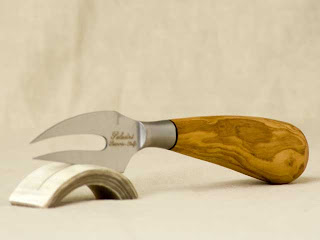
-    There are special knifes with two tips, for small pieces and soft cheeses. With this tool you can serve directly to the plate. Tip: normally dull knives cut better than the sharp. If heated slightly (eg by soaking in hot water) the blade will slide by the cheese as it was butter.


-    The ‘girolle’ is a tool with a wood round base and a blade attached to a shaft at its top, which allows to make rosette-shape pieces.


-     Graters are useful for skim hard and extra hard cheeses. For rigid is better to use small holes graters, to make thin strips. For semi-rigid is more appropriate to use large holes graters, resulting larger cheese strips. To grate cheese, electric grinders can also be used.

 We hope have helped you to know more about cheese. We recommend one of the best Spanish cheeses: Pago LosVivales. Cheeses of sheep milk, from tender to very cured, they are a tasty and really high quality delicacy. Remember: you can eat just cheese, or with Spanish Ham and a good red wine

viernes, 4 de mayo de 2012

Serrano Ham with Crusty Tomato Bread


This is one of the most typical tapas in Spain. Sweet tomato with a little bit of garlic, all spread on bread is perfect for some slices of Spanish Jamon. Let's see how to prepare it, it´s so easy! 


INGREDIENTS (for 12 servings)
  • 12 plum tomatoes (they are called 'plum' beacuse this type of tomato is smaller and has less water. Kind of dry. But you can use any type of tomato)
  • 2 teaspoons oregano
  • 3/4 teaspoon salt
  • 4 spoons garlic oil (oil has been infused with fresh garlic)
  • 1 whole-grain baguette (cut in 24 slices)
  • 6 ounces thin sliced Spanish Ham (for expample: Jamon from Teruel, really fantastic!)
Tomato with garlic on a bread slice

PREPARATION

Preheat oven to 150ºC and coat a large rimmed baking sheet with oil. Cut tomatoes in half lengthwise and place on the baking sheet. Sprinkle all with oil (extra virgin olive oil is quite better), some oregano and salt. Roast for 1 hour. When finish with the oven, coarsely chop the tomatoes and transfer to a bowl to serve (all juices included).

To serve in tapas: preheat oven to 180ºC. Place bread slices on a baking sheet and brush with garlic oil. Bake 3 minutes (maybe 4) per side. Let cool slightly. To serve, arrange bread and ham in a big plate and the bowl of tomato for spreading. Also, you can chop some garlic and spread on the tomato mixture.   
.
That's all! Enjoy this delicious tapa with the best Spanish Jamon.

Spanish Jamon from Teruel on a bread slice with tomato and garlic sauce

viernes, 20 de abril de 2012

Types of Spanish Iberico and Serrano Ham


Jamon (Spanish for ham) Iberico or Serrano is in addition to caviar,foie and black truffles, the fourth finest and valued flavour in the world, as ensuring the best chefs and experts. The exclusivity of this food, only made in some regions of Spain, perfect because of its climate, tradition and know-how, makes it one of the most sought after and asked for. A truly gourmet delight.


But, what do we know about the different kinds of Jamon? What is exactly a Jamon Iberico or a Jamon Serrano? Well, the biggest difference is in the feeding of the animals, and the types of pigs.

Mainly we can find two breeds of pigs in Spain:

Black Iberian: This legendary and select race has many qualities, including a great capacity to accumulate fat under its skin and between the muscular fibres. This is what produces the typical white streaks that make it special. It’s the only breed used to makeIberico ham. Only in some cases, pigs grow and live freely in the dehesa (meadow), where they can run and do exercise, what is perfect for the hams.


White pig: is a cross between Large White and Landrace (mother side) and Duroc breed (father side). These races allow to obtaining quality hams with low levels of dietary cholesterol (high in unsaturated fats and low in saturated fat). It’s used to make Serrano ham.


So, from the back leg of a Black Iberian pig we can make:

-        Jamon Iberico de Bellota(Spanish for acorn): is the top grade of Spanish ham. Bellota means that the pig has been fed exclusively on a diet of acorns and herbs. This feeding gives the hams a very rich flavour and smooth texture. These hams need to be cured for at least 24 months. The world most famous brand is Joselito.


-        Jamon Iberico de Recebo: the pig has been fed a mixed diet including both acorns and compound feed (cereals mainly). The hams take some flavour of the acorn, but with less intensity.

-        Jamon Iberico de Cebo: pigs raised in a compound feed diet. Anyway, the breed makes an excellent ham even without the acorn diet, with a very smooth texture and good flavour.  


And from the back leg of a White Spanish pig we can make:

-          Jamon Serrano: this indicates that the pig has grown (and the ham has been made) in a mountain range, so is used to indicate a wide range of hams. The salting and curing process is the same as for the Iberico ham, but usually for less time. Flavours range from mild and full flavoured, excellent as well. Jamon Serrano is the staple of most Spanish families and restaurants and accounts for 90% of ham production in Spain.

-          Jamon from Teruel: this refers to a PDO (Protected Designation of Origin by EU Authorities) type of ham made exclusively in Teruel, a region with perfect conditions, including climate, for raising pigs and curing process. Jamon from this area has an special flavour, highly valued and appreciated by top Spanish chefs, who often use it in their recipes and restaurants. PDO Council lays down rules that ensure the high quality of this ham. There are really strict rules for growth and feeding pigs, for the curing process, even for the altitude (800 m.a.s.l.) and the geographical area at which the hams are to be made. There are many brands and small companies of Jamon from Teruel, but undoubtedly, the most recognized for its quality and special flavour is Antonio Mata.


And what is a Paleta? Simple: a Jamon is made from the back leg of a pig. The Paleta or Paletilla is made from the front leg (shoulder cut). Obviously the Jamon has more meat than the Paleta because the size difference, as it’s smaller (but less expensive).

We hope helped to tell the different types of Jamon and its qualities for your next purchase

viernes, 13 de abril de 2012

Spanish foods: Cheese from Zamora


Spain has a long tradition of producing cheese. Many cheeses are made in Spain, some of them are internationally renowned, and also there are many PDO. Throughout the entire country there is a wide variety of cheeses made from the milk of cows, goats and sheep. Some of them are manufactured from single types of milk of sheep, goat or cow and a few are mixtures of different milks.

There is a huge variation in the presentation of the cheeses, from the hard, dark-skinned, to the soft, small and tender. The cheeses are made in a wide variety of styles including fresh, matured, semi-matured, and from different types of milk such as pasteurised, unpasteurised or creamy. Therefore, some of them are inoculated with moulds to make blue varieties.

We are going to analyze and describe some characteristics of each producing area in different posts, but today we want to talk about Cheese from Castilla y Leon, the largest region of Spain.


Castilla y Leon is one of the oldest regions of Spain, as it was from where it started the Spanish reconquest in the Middle Ages. Many products are made on the traditional way. Its cuisine is based on roast and cooked meats, most notably roast lamb, black pudding (morcilla), legumes, the humble and great garlic soup, and red, rosé, claret and white PDO wines.

But definitely, there are two notably foods in this area: Jamon and CheeseSpecifically cheese from Zamora, a province of Castilla y Leon, is really known. This is a hard cheese which is typically aged about alt least 6 months. The cheeses are turned often and rubbed with olive oil, giving the cheese its characteristic dark colour. The secret of its flavour is the breed of sheep, the ‘Churra’: small, scruffy and predominant Castilian sheep.


The cheese is hard and nutty, but creamy, sweet and savory flavour. Some of them are a bit spicy. So similar to the famous Manchego cheese, its shape is cylindrical with a distinctive zig zag pattern.

Chesees from Zamora are protected and controlled by its PDO (Protected Designation of Origin by the EU) which specifies its production, ingredients, and maturation.


Blue Label – Fresh: short maturation, milk-white colour.

Green Label – Semi-matured: melting in the mouth. From 3 to 5 months of curing process.

Black Label – Matured: thick and bit dry, but pleasant flavour, its colour is ivory-white. The curing process takes from 7 to 9 months.

Burgundy label – Aged or Reserva: honey colour, stong and aromatic, reminiscent of sheeps flavour. More than 11 months of maturation.


Cheese in Spain is served sliced as a tapa, usually together with Jamon, sausages and other cold meats. But it’s quite ordinary to see a group of friends sitting at the table and tasting different kids of cheese. The Spanish are really good cheese producers, one of our greatest treasures indeed. But above all, we are excellent tasters not only of Spanish cheese, but of the whole world.

In the coming weeks, we will continue talking about cheeses from other parts of Spain, as Manchego, Spanish most valued cheese.