Mostrando entradas con la etiqueta cheese. Mostrar todas las entradas

miércoles, 17 de octubre de 2012

Tile of Cream Patamulo Cheese with Crispy Ham from Teruel


Today we will make a recipe using two of the most typical products of Aragon, specifically in the province of Teruel. Patamulo Cheese from Bajo Aragon has its heart in places like the small village of Samper de Calanda. It has a nice texture, and very distinguished tastes that is easily identified. Made by the traditional way, its curing process is from 2 to 4 months. And the Ham fromTeruel PDO is definitely the star of the products of the province, and a pride for all Aragonese and Spanish. Followers of this blog and Antonio Mata perfectly know the virtues of this excellent cured ham. Let's see how to prepare an appetizer that is a perfect combination of cheese and ham:

TILE OF CREAM PATAMULO CHEESE WITH CRISPY HAM FROM TERUEL

Photo www.elmundoiberico.com


Ingredientes:
  • Ham from Teruel PDO by Antonio Mata
  • 250 grams Patamulo Cheese
  • Pedro Ximénez Reduction
  • 2 egg whites
  • 20 gr. sifted flour
  • 20 gr. butter cream point
  • Milk
  • Cream
  • Butter
  • 1 pinch of salt
  • Black pepper


Preparation:

To make the cream cheese Patamulo, heat it over high heat 150 ml of milk and 150 ml of cream and butter. Season with salt and black pepper. When very hot add the cheese Patamulo (previously diced) and we will remove constantly until melted. Tip, if it is too runny, let's take a little cornstarch to thicken.

To make the tiles: Preheat oven to 180 º C. Whisk the egg whites until stiff and mix hard with butter and flour until a smooth dough. Put baking paper on a tray and make mounds with the dough. They should be round and we have to crush them flat. We'll leave in the oven for about 10 minutes until golden and then remove and let cool. Meanwhile, in another pan put 3 slices of Ham from Teruel PDO by AntonioMata. We'll leave them until the texture is crunchy. Surely the ham will take longer than the tiles.

Once made the ham, chop it and mix well with the cream cheese Patamulo. To serve, we will make a ball of cream cheese and ham on each tile and add a little ham over each ball. We can add a dash of Pedro Ximénez reduction.

And that's it. This is a dish that you shall be as great chefs before your guests but not a very complicated processing. We hope you feel encouraged to try at home.

See you next Friday with more recipes and tapas!


miércoles, 22 de agosto de 2012

Cured ham and Brie cheese croquettes


Today we propose a recipe that requires some work and preparation, especially for the bechamel. But don’t alarm, the result is superb: Spanish Cured Ham and Briecheese croquettes.


Ingredients:


Preparation:

We take a stream of Olive Oil and two dices of butter in a terracotta casserole and wait to melt. Cut the Spanish Cured Ham into small pieces or chunks and add to the casserole. Tip: Cured Ham is fried very quickly, so have it half or a minute.

Add 3 or 4 tablespoon of flour and stir for binding with butter. Then we pouring milk slowly, don’t stop to stir, this is very important. Also add the diced Brie and continue stirring until dissolve them. Add salt. The bechamel has to be quite thick. Let cool in the fridge.

When mix is hard, we shape the croquettes. Cover them with egg and breadcrumbs and fry in a pan with abundant hot olive oil.

And that’s it, now I am enjoying this delicacy. Feel sure that will repeat this recipe, because will love it at home, especially because of the Spanish Cured Ham that will give a special flavor.

viernes, 18 de mayo de 2012

Pairing cheese and wine


Everytime we taste a cheese think of a situable wine to accompany (at least in Spain). Nothing is so linked to tradition of cheese as wine and Spanish Ham. And seems obvious that cheese tastes better with wine. Years ago in Spain, when you went to buy a bottle of wine, was common to buy a cheese in the same store.


We’re going to propose different combinations of cheese and wine, depending on its composition, texture, age and obviously, flavour.

Normally we tend to think that a strong cured cheese goes well together with a strong and potent wine. Not true! A general rule we can follow (contrary to popular belief) is always offset a sharp cheese with sweet or aromatic wine. As well, is really good to pair acid and fresh wines with fatty cheeses.


Here we go!

  • Sharp cheese (old Gouda, Parmeggiano, ‘Bajoragon’ aged cheese): Syrah and Zinfandel red, strong bouquet and sometimes smoked.

  • Aged or cured sheep cheese (Zamorano ‘Pago Los Vivales’ Curado): Oporto Tawny, if we want a white, Gewurztraminer, low acidity and extremely aromatic. Regarding reds, Syrah or maybe Merlot, very aromatic.


  • Mild sheep cheese (‘Don Luis’ rosemary): Pinot Noir, no tannin and aromatic. With really smooth cheeses, even a Riesling, a bit of acidity and very aromatic. You can choose Gramona Riesling.


  • Semi-hard cheeses or not excessively strong (Brie, Tetilla, Idiazabal, Emmental, Semi-hard ‘Rubielos’): Tempranillo, as Pago de los Capellanes 2007.


  • Fresh cheese (Arla Avarti): Champange, Spanish cava or Riesling, a bit of acidity and aromatic, as Gramona Brut Imperial.


  • Goat cheese (Puro de Cabra ‘La Cabrita): Sauvignon Blanc, aromatic and acidity, as Gramona Gessami.


  • To all kind of cheese: if we want a grape that goes relatively well with any cheese, you can choose the Viogner, medium acidity and a great bouquet range.


That’s all! Hope to help you to enjoy this ancient tradition of pairing cheese and wine. In Spain, we always add our superb Spanish Ham, especially with our loved Jamón fromTeruel.

Bon appetit!


via @Vinnum

viernes, 11 de mayo de 2012

How to cut cheese: ways, types and tools


Cheese is one of the products we love, because is the perfect partner for the Spanish Ham (but red wine as well). As you know, there are so many varieties and sometimes is difficult to know how cut and serve each one properly.


First of all, a bit of History about cheese:

Cheese is one of the oldest foods of mankind. The ancient Greeks believed it had healing properties. Attila ate cheese made from mare’s milk. And the Romans, great cheese manufacturers, extended its consume and tradition around the Empire.

Throughout History, man had devises several ways to make cheese, different tastes and textures. Nowadays, many cheeses are made using traditional methods, but the process has been improved thanks to technical developments.


Cheese is only the remaining solid matter when you remove milk serum, by pressure or cooking. All cheeses are made from milk, whether cow, goat, sheep (really good in Spain) even donkey. You know that famous Cleopatra’s story, don’t you?


Well, and how to cut cheese?
Cheeses have different shapes and sizes, and it’s not easy to know how to cut each type. To avoid unnecessary waste and make each piece more appetizing, it’s interesting to use a proper technique for each one.

-    Soft cheeses (round or square), and the moldy, have to be cut into small pieces.
-    Cylindrical cheeses are cut in two parts.
-    Those roll or bar-shaped have to be cut into individual slices (thicker or thinner, depending on the guests).
-    If it’s a ball, first split in half, then cut a hexagonal piece, and from this you can make slices.


Ok! It seems easy. But, what about tools for cut cheese?

All cheeses can be cut with a knife (obviously), but according to their consistency and texture is more appropriate to use a special cutting tool.

-    The extra hard cheeses can’t be cut into sliced, it’s better to break them. Is necessary a small short knife. The tip should be applied to the cheese and as a lever to cut it down.


-    For cutting large cheeses is used a strand wire. First crust is marked for strand wire slides easily.
-    Moldy semi-rigid, which normally are brittle, are also cut with a strand wire. Tip: cut it right out of the fridge (the hotter, the softer).
-    To slice moldy rigid, cream or roll cheese, use the bow. In this case, the strand wire is fixed in a carrier.
-    Hard cheeses can be cut with a palette knife. But they are small normally, so if is a large cheese, use a big knife with a wide blade.


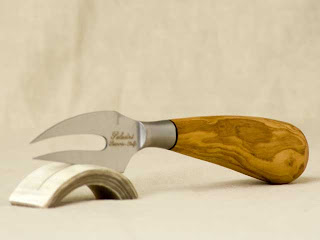
-    There are special knifes with two tips, for small pieces and soft cheeses. With this tool you can serve directly to the plate. Tip: normally dull knives cut better than the sharp. If heated slightly (eg by soaking in hot water) the blade will slide by the cheese as it was butter.


-    The ‘girolle’ is a tool with a wood round base and a blade attached to a shaft at its top, which allows to make rosette-shape pieces.


-     Graters are useful for skim hard and extra hard cheeses. For rigid is better to use small holes graters, to make thin strips. For semi-rigid is more appropriate to use large holes graters, resulting larger cheese strips. To grate cheese, electric grinders can also be used.

 We hope have helped you to know more about cheese. We recommend one of the best Spanish cheeses: Pago LosVivales. Cheeses of sheep milk, from tender to very cured, they are a tasty and really high quality delicacy. Remember: you can eat just cheese, or with Spanish Ham and a good red wine

viernes, 13 de abril de 2012

Spanish foods: Cheese from Zamora


Spain has a long tradition of producing cheese. Many cheeses are made in Spain, some of them are internationally renowned, and also there are many PDO. Throughout the entire country there is a wide variety of cheeses made from the milk of cows, goats and sheep. Some of them are manufactured from single types of milk of sheep, goat or cow and a few are mixtures of different milks.

There is a huge variation in the presentation of the cheeses, from the hard, dark-skinned, to the soft, small and tender. The cheeses are made in a wide variety of styles including fresh, matured, semi-matured, and from different types of milk such as pasteurised, unpasteurised or creamy. Therefore, some of them are inoculated with moulds to make blue varieties.

We are going to analyze and describe some characteristics of each producing area in different posts, but today we want to talk about Cheese from Castilla y Leon, the largest region of Spain.


Castilla y Leon is one of the oldest regions of Spain, as it was from where it started the Spanish reconquest in the Middle Ages. Many products are made on the traditional way. Its cuisine is based on roast and cooked meats, most notably roast lamb, black pudding (morcilla), legumes, the humble and great garlic soup, and red, rosé, claret and white PDO wines.

But definitely, there are two notably foods in this area: Jamon and CheeseSpecifically cheese from Zamora, a province of Castilla y Leon, is really known. This is a hard cheese which is typically aged about alt least 6 months. The cheeses are turned often and rubbed with olive oil, giving the cheese its characteristic dark colour. The secret of its flavour is the breed of sheep, the ‘Churra’: small, scruffy and predominant Castilian sheep.


The cheese is hard and nutty, but creamy, sweet and savory flavour. Some of them are a bit spicy. So similar to the famous Manchego cheese, its shape is cylindrical with a distinctive zig zag pattern.

Chesees from Zamora are protected and controlled by its PDO (Protected Designation of Origin by the EU) which specifies its production, ingredients, and maturation.


Blue Label – Fresh: short maturation, milk-white colour.

Green Label – Semi-matured: melting in the mouth. From 3 to 5 months of curing process.

Black Label – Matured: thick and bit dry, but pleasant flavour, its colour is ivory-white. The curing process takes from 7 to 9 months.

Burgundy label – Aged or Reserva: honey colour, stong and aromatic, reminiscent of sheeps flavour. More than 11 months of maturation.


Cheese in Spain is served sliced as a tapa, usually together with Jamon, sausages and other cold meats. But it’s quite ordinary to see a group of friends sitting at the table and tasting different kids of cheese. The Spanish are really good cheese producers, one of our greatest treasures indeed. But above all, we are excellent tasters not only of Spanish cheese, but of the whole world.

In the coming weeks, we will continue talking about cheeses from other parts of Spain, as Manchego, Spanish most valued cheese.